





Chemistry: Where Curiosity Unlocks the Secrets of Matter
Michelle Zou
Lead Teacher of Chemistry
Many parents share a similar concern: why is it that although their child is clearly intelligent, Chemistry still feels dull, difficult and challenging to remember? Between endless formulas, symbols and exercises, a pupil’s natural curiosity is often stifled before it has the chance to grow. But at Wellington College Education (China) – Hangzhou, this traditional perception is being steadily overturned.
We firmly believe that what truly helps a pupil fall in love with Chemistry is not talent, but method—not rote memorisation, but exploration. For this reason, we have built a completely different approach to Chemistry learning, one that invites pupils to enter the classroom with a sense of wonder, understand the world through scientific methods and embrace the future with logic and critical thinking. Through the three core questions that follow, you will see why Chemistry learning here keeps pupils genuinely 'hooked'.
What should a Chemistry classroom look like?
When you think of a typical senior school Chemistry lesson, what comes to mind? Densely packed notes on the board, pages filled with chemical symbols? A strict teacher behind thick glasses? Or perhaps a 'magic show' featuring mysterious bottles and explosive reactions? In the Chemistry classrooms at Wellington College Education (China) - Hangzhou, none of these stereotypes can stand. We never replicate a one-size-fits-all lesson model, yet we always uphold one core principle - every pupil should be guided by curiosity as they actively explore the chemistry secrets of the world. Every teaching method is designed for this single purpose.
Edison once said, "Surprise is the seed of science." Our Chemistry lessons are the fertile soil in which this seed grows. Each lesson begins with a carefully designed activity or inquiry question—
"Why does a balloon rubbed with a towel bend a stream of water?"
"Why does an apple turn brown after being cut?"
These everyday, curiosity-sparking questions instantly draw pupils in. We never rush to provide answers; instead, we offer pupils the space to think and an atmosphere where all ideas can be voiced and challenged.
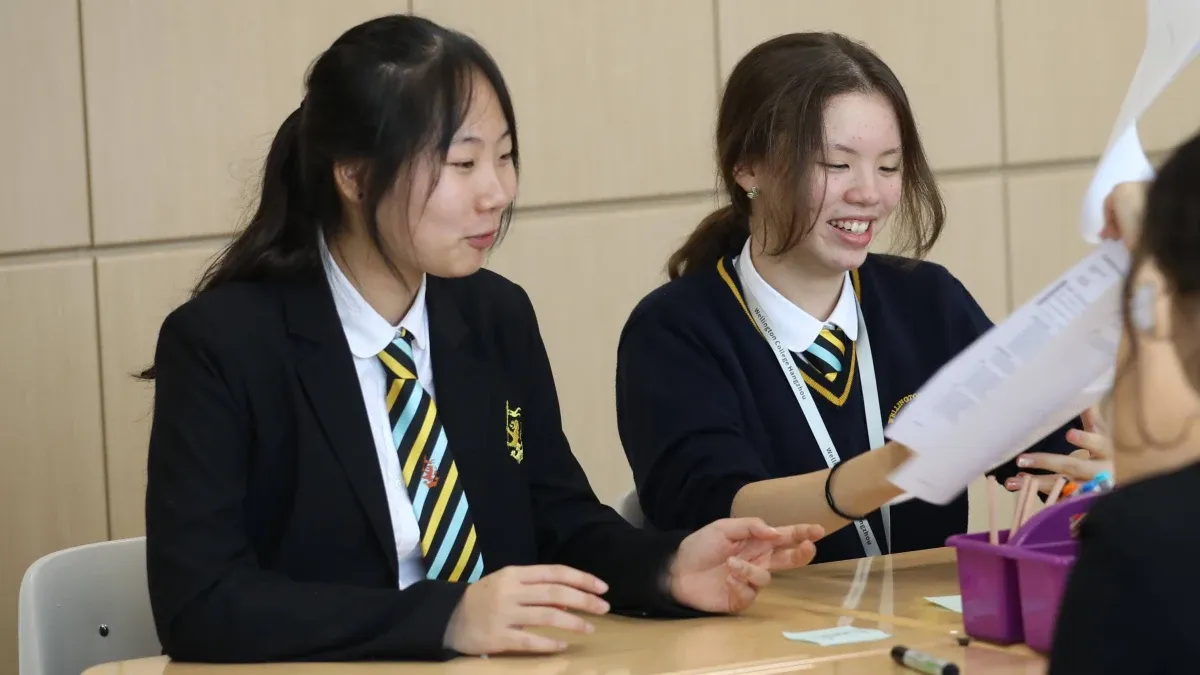
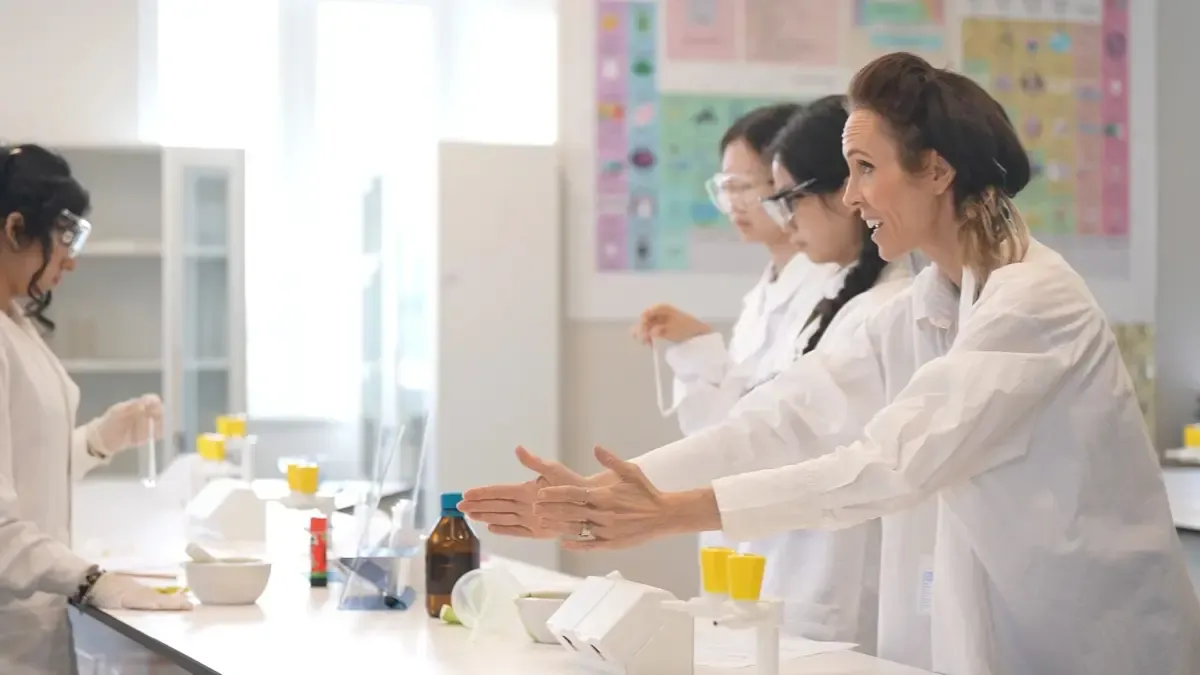
More importantly, we value the learning differences of every pupil. Some excel in visual memory, some prefer hands-on work, and others grasp concepts more easily in group discussions. As a result, our classrooms are constantly 'shape-shifting': during input, we use images, diagrams, animations and experiment videos; during output, pupils might explain verbally, illustrate their thinking, or even act out molecular movement. In practical activities—whether group experiments, data investigations, Chemistry games, or creative videos—each pupil can find a rhythm that suits them and experience Chemistry from multiple dimensions.
Our aim is no longer "Can you memorise?"
but "Can you apply?"
Assistant Professor Shen Xincheng of Shanghai Jiao Tong University once remarked in a talk that traditional exams overemphasise memorisation—pupils who score full marks in English might still struggle to hold a fluent conversation. Likewise, a pupil who has memorised the periodic table may still be unable to calculate reaction yields, let alone prepare copper sulphate crystals. In an age where AI can retrieve information instantly, 'memory advantage' is fading; what AI cannot replace—independent thinking, logical analysis and problem-solving—has become the true core competency for the future.
“The abilities most valued in the Gaokao have become the least relevant in the age of AI.”
In an age where AI can retrieve information instantly, 'memory advantage' is fading; what AI cannot replace—independent thinking, logical analysis and problem-solving—has become the true core competency for the future.
This is precisely the aim of our Chemistry teaching and assessment: we do not test 'what you can recite', but 'what you truly understand and can use'. Whether in internal assessments or external examinations, what we measure is a pupil’s ability to comprehend, break down and solve problems.
To cultivate this ability, we never 'feed pupils the answer'. For example, when teaching how to write laboratory reports, we first show pupils a seemingly rigorous scientific report titled 'Chocolate Helps You Lose Weight.' Just as they are about to be convinced by its 'professional conclusion', we reveal author John Bohannon's 'confession letter', exposing how a poorly designed experiment had misled millions of readers.
This eye-opening case helps pupils immediately understand why fairness and logic in experimental design matter—core skills assessed in IGCSE and A Level practical questions —and, even more critically, the scientific mindset that protects them from misinformation in the future. We aim to nurture learners who can think independently, question critically and solve real-world problems.
Doing well in Chemistry has never
been about talent, but about method
Over the years, I have found one key pattern: the most significant gap between high-achieving pupils and those currently struggling is not talent or interest, but whether they have mastered the learning methods suited to Chemistry. Talent might give a pupil a temporary head start, but without method, progress stalls; interest may create short-term excitement, but only scientific methods sustain long-term motivation.
The core role of a Chemistry teacher, therefore, is to become a guide to effective methods. The beauty of Chemistry lies in explaining the macroscopic world through microscopic principles, yet its abstractness often discourages pupils. To bridge this, we bring abstract concepts into real life: using table salt and water to explain concentration, analysing rusting to illustrate oxidation, guiding pupils to make 'homemade fizzy drinks' to experience acid–base reactions. When pupils discover that 'Chemistry is everywhere', and when abstract theories become tangible practice, learning shifts from passive reception to active exploration.
We firmly believe that when pupils find methods that suit them, they not only overcome Chemistry challenges with ease, but also gain the empowering sense of 'using knowledge to solve real problems'—a capability that AI cannot replace and one that will become their core strength as they face future challenges.
In the Chemistry classrooms at Wellington College Education (China) – Hangzhou, there are no constraints of a 'standard answer', only the passion of exploring the unknown. There are no rigid teaching models, only personalised support for growth. Here, Chemistry learning is more than the accumulation of knowledge—it is a transformation of thinking. We look forward to exploring the wonders of the chemical world together with your child.
Related Articles
_1765959305621.png?x-oss-process=image/interlace,1/resize,m_lfit,w_1200/quality,q_90/format,webp)