最新资讯
Latest News
Mathematics is often described as a universal language—a notion that resonates deeply with the ethos at Wellington College International Hangzhou Primary School. At this school, mathematics is not merely a subject but a conduit for fostering critical thinking, problem-solving skills and a global mindset. The school's commitment to offering a comprehensive and challenging mathematics curriculum draws from the best of both English and Shanghai Maths learning objectives, ensuring pupils are well-equipped for future academic pursuits.
CPA Approach:
The Foundation of Understanding
At the core of Wellington College International Hangzhou's mathematics teaching lies the CPA (Concrete-Pictorial-Abstract) approach. This well-regarded pedagogical framework is pivotal in helping pupils grasp complex mathematical concepts. The CPA approach aligns with Bruner's theory of cognitive development, which suggests effective learning occurs when teaching progresses from concrete to abstract stages. It begins with concrete experiences, where pupils interact with physical objects to model mathematical ideas. For instance, the use of blocks and counters makes abstract arithmetic concepts more accessible, aiding in the development of number sense.

The transition from concrete to pictorial representations is seamless at Wellington College International Hangzhou. Pupils progress from manipulating objects to drawing models, enhancing their visualisation skills. Diagrams, number lines and visual aids are integral in this phase, establishing a bridge between tangible experiences and abstract reasoning. By the time pupils reach the abstract stage, they are confident in using mathematical symbols and notations to solve complex problems.
An example of this in action is evident in a Year 3 class, where pupils explore fractions. They begin by using physical objects, such as paper strips and fraction circles, to divide and understand wholes and their parts. Research supports this method, indicating that physical manipulation enhances understanding (Moyer & Jones, 1998). As pupils become more comfortable, they draw fraction bars and finally solve problems using numerical fractions. This logical progression ensures that no child is left behind and that mathematical concepts are deeply rooted in their understanding.
Investigatory Learning:
Cultivating Curiosity through Anchor Tasks
Investigatory learning at Wellington College International Hangzhou positions pupils as active participants in their educational journey, fostering a profound engagement with mathematical concepts. This approach draws inspiration from Vygotsky's social constructivist theory, which highlights the critical role of social interaction and discovery in effective learning processes. By incorporating inquiry-based activities and open-ended questions, pupils at Wellington College develop curiosity and the skills necessary to explore mathematical concepts beyond the confines of the syllabus, thereby reinforcing their analytical prowess and nurturing creativity and independent thinking.
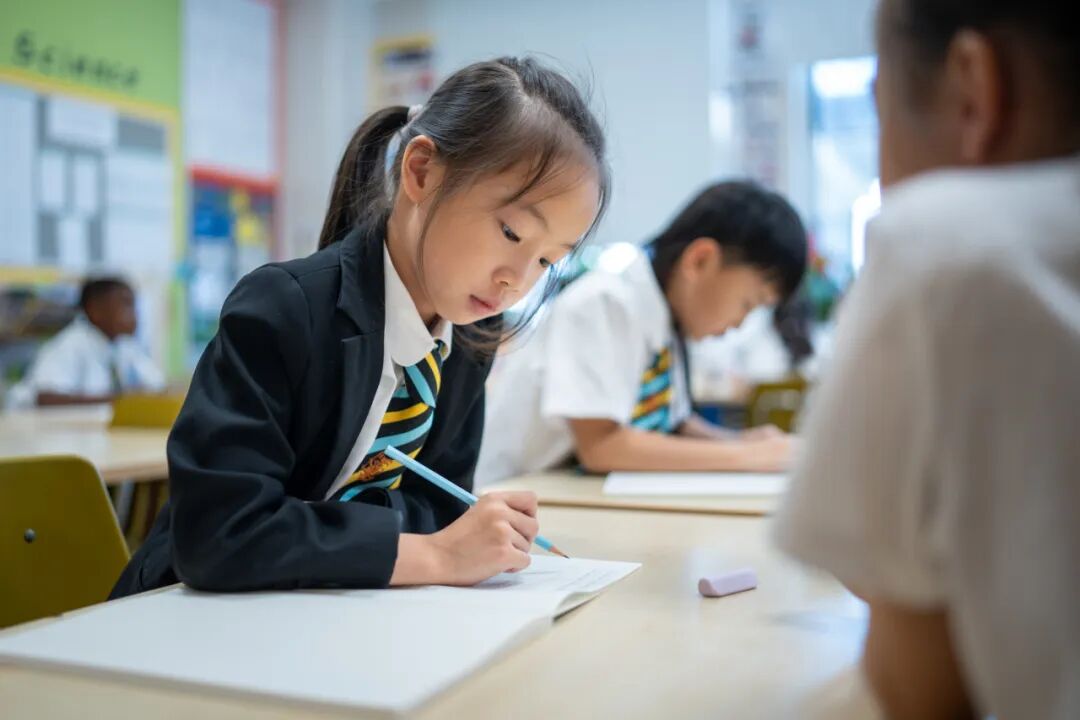
Central to this investigatory approach is the strategic use of anchor tasks in maths lessons. Anchor tasks are exploratory challenges presented at the start of a lesson, designed to engage pupils and encourage them to apply prior knowledge to new problems. These tasks catalyse inquiry and investigation, compelling pupils to delve deeper into mathematical themes with enthusiasm and intent.
For instance, an anchor task might introduce a real-world scenario requiring strong reasoning skills, prompting pupils to consider various solutions and pathways. As pupils work through these tasks, they engage in collaborative discourse and problem-solving, refining their reasoning and justification skills. Opportunities for reasoning and justifying are inherently embedded within these activities. Pupils are encouraged to present their findings and defend their conclusions, thereby honing their ability to communicate mathematical reasoning with clarity and effectiveness.
Problem Solving:
Preparing for Real Life Challenges
Problem-solving at Wellington College International Hangzhou is not confined to textbook exercises; instead, it is an integrated process that is woven into daily lessons. This approach echoes Polya's problem-solving principles, which emphasise understanding the problem, devising a plan and looking back at the solution to ensure it makes sense. By engaging with real-world problems, pupils see the relevance of mathematics in everyday life. Teachers pose challenging questions and scenarios that require deep thinking and collaborative efforts to resolve.
These problem-solving tasks are aligned with both the English National Curriculum and Shanghai Maths objectives, ensuring that pupils benefit from the strengths of both educational systems while gaining a well-rounded skill set.

Dual Curriculum:
The Best of Both Worlds
The integration of the English National Curriculum with Shanghai Maths objectives exemplifies Wellington College International Hangzhou's commitment to high standards and global perspectives. The English curriculum's emphasis on investigative techniques and problem-solving complements Shanghai's reputation for rigour and depth in fundamental skills, as well as the approach known as 'mastery'. Research shows mastery approaches, as promoted in Shanghai, lead to significant improvements in pupils' mathematical understanding and achievement (NCETM, 2020). One way in which the Shanghai approach helps promote the ‘mastery’ of maths is through activities that ask pupils to ‘calculate smartly’. This not only challenges but also assists in the development of pupils’ understanding of numbers to a higher level by enabling them to manipulate the numbers in equations to make them easier to solve.
Daily mathematics sessions are meticulously planned to cover key objectives from both curricula, with regular maths lessons complemented by shorter arithmetic sessions of 10-15 minutes. This ensures a blend of conceptual understanding and arithmetic proficiency. This dual approach not only caters to international pupils but also respects and incorporates local educational aspirations. The emphasis on critical thinking, reasoning and problem-solving produces resilient learners capable of navigating diverse educational landscapes.

Conclusion: Building a Strong Foundation
for Future Success
At Wellington College International Hangzhou Primary School, mathematics is taught not as an abstract concept but as a vital skill set for life. Through the thoughtful application of CPA principles, investigative learning and problem-solving tasks, the school prepares pupils to face future academic and real-world challenges with confidence.
By merging the strengths of both the English National Curriculum and Shanghai Maths learning objectives, Wellington College International Hangzhou equips its pupils with a unique blend of skills that transcend cultural and educational boundaries. As these young minds grow, the strong mathematical foundation laid at this innovative institution ensures they are ready to excel in any path they choose to pursue.

The dedication of teachers and the support of the school community create a nurturing environment where mathematical learning thrives, affirming Wellington College International Hangzhou's status as a pioneer in international education. In this ever-evolving global landscape, the school's mathematics programme truly stands out for its ability to inspire, challenge and transform young learners into confident, capable individuals.








Mathematics is often described as a universal language—a notion that resonates deeply with the ethos at Wellington College International Hangzhou Primary School. At this school, mathematics is not merely a subject but a conduit for fostering critical thinking, problem-solving skills and a global mindset. The school's commitment to offering a comprehensive and challenging mathematics curriculum draws from the best of both English and Shanghai Maths learning objectives, ensuring pupils are well-equipped for future academic pursuits.
CPA Approach:
The Foundation of Understanding
At the core of Wellington College International Hangzhou's mathematics teaching lies the CPA (Concrete-Pictorial-Abstract) approach. This well-regarded pedagogical framework is pivotal in helping pupils grasp complex mathematical concepts. The CPA approach aligns with Bruner's theory of cognitive development, which suggests effective learning occurs when teaching progresses from concrete to abstract stages. It begins with concrete experiences, where pupils interact with physical objects to model mathematical ideas. For instance, the use of blocks and counters makes abstract arithmetic concepts more accessible, aiding in the development of number sense.
The transition from concrete to pictorial representations is seamless at Wellington College International Hangzhou. Pupils progress from manipulating objects to drawing models, enhancing their visualisation skills. Diagrams, number lines and visual aids are integral in this phase, establishing a bridge between tangible experiences and abstract reasoning. By the time pupils reach the abstract stage, they are confident in using mathematical symbols and notations to solve complex problems.
An example of this in action is evident in a Year 3 class, where pupils explore fractions. They begin by using physical objects, such as paper strips and fraction circles, to divide and understand wholes and their parts. Research supports this method, indicating that physical manipulation enhances understanding (Moyer & Jones, 1998). As pupils become more comfortable, they draw fraction bars and finally solve problems using numerical fractions. This logical progression ensures that no child is left behind and that mathematical concepts are deeply rooted in their understanding.
Investigatory Learning:
Cultivating Curiosity through Anchor Tasks
Investigatory learning at Wellington College International Hangzhou positions pupils as active participants in their educational journey, fostering a profound engagement with mathematical concepts. This approach draws inspiration from Vygotsky's social constructivist theory, which highlights the critical role of social interaction and discovery in effective learning processes. By incorporating inquiry-based activities and open-ended questions, pupils at Wellington College develop curiosity and the skills necessary to explore mathematical concepts beyond the confines of the syllabus, thereby reinforcing their analytical prowess and nurturing creativity and independent thinking.
Central to this investigatory approach is the strategic use of anchor tasks in maths lessons. Anchor tasks are exploratory challenges presented at the start of a lesson, designed to engage pupils and encourage them to apply prior knowledge to new problems. These tasks catalyse inquiry and investigation, compelling pupils to delve deeper into mathematical themes with enthusiasm and intent.
For instance, an anchor task might introduce a real-world scenario requiring strong reasoning skills, prompting pupils to consider various solutions and pathways. As pupils work through these tasks, they engage in collaborative discourse and problem-solving, refining their reasoning and justification skills. Opportunities for reasoning and justifying are inherently embedded within these activities. Pupils are encouraged to present their findings and defend their conclusions, thereby honing their ability to communicate mathematical reasoning with clarity and effectiveness.
Problem Solving:
Preparing for Real Life Challenges
Problem-solving at Wellington College International Hangzhou is not confined to textbook exercises; instead, it is an integrated process that is woven into daily lessons. This approach echoes Polya's problem-solving principles, which emphasise understanding the problem, devising a plan and looking back at the solution to ensure it makes sense. By engaging with real-world problems, pupils see the relevance of mathematics in everyday life. Teachers pose challenging questions and scenarios that require deep thinking and collaborative efforts to resolve.
These problem-solving tasks are aligned with both the English National Curriculum and Shanghai Maths objectives, ensuring that pupils benefit from the strengths of both educational systems while gaining a well-rounded skill set.
Dual Curriculum:
The Best of Both Worlds
The integration of the English National Curriculum with Shanghai Maths objectives exemplifies Wellington College International Hangzhou's commitment to high standards and global perspectives. The English curriculum's emphasis on investigative techniques and problem-solving complements Shanghai's reputation for rigour and depth in fundamental skills, as well as the approach known as 'mastery'. Research shows mastery approaches, as promoted in Shanghai, lead to significant improvements in pupils' mathematical understanding and achievement (NCETM, 2020). One way in which the Shanghai approach helps promote the ‘mastery’ of maths is through activities that ask pupils to ‘calculate smartly’. This not only challenges but also assists in the development of pupils’ understanding of numbers to a higher level by enabling them to manipulate the numbers in equations to make them easier to solve.
Daily mathematics sessions are meticulously planned to cover key objectives from both curricula, with regular maths lessons complemented by shorter arithmetic sessions of 10-15 minutes. This ensures a blend of conceptual understanding and arithmetic proficiency. This dual approach not only caters to international pupils but also respects and incorporates local educational aspirations. The emphasis on critical thinking, reasoning and problem-solving produces resilient learners capable of navigating diverse educational landscapes.
Conclusion: Building a Strong Foundation
for Future Success
At Wellington College International Hangzhou Primary School, mathematics is taught not as an abstract concept but as a vital skill set for life. Through the thoughtful application of CPA principles, investigative learning and problem-solving tasks, the school prepares pupils to face future academic and real-world challenges with confidence.
By merging the strengths of both the English National Curriculum and Shanghai Maths learning objectives, Wellington College International Hangzhou equips its pupils with a unique blend of skills that transcend cultural and educational boundaries. As these young minds grow, the strong mathematical foundation laid at this innovative institution ensures they are ready to excel in any path they choose to pursue.
The dedication of teachers and the support of the school community create a nurturing environment where mathematical learning thrives, affirming Wellington College International Hangzhou's status as a pioneer in international education. In this ever-evolving global landscape, the school's mathematics programme truly stands out for its ability to inspire, challenge and transform young learners into confident, capable individuals.